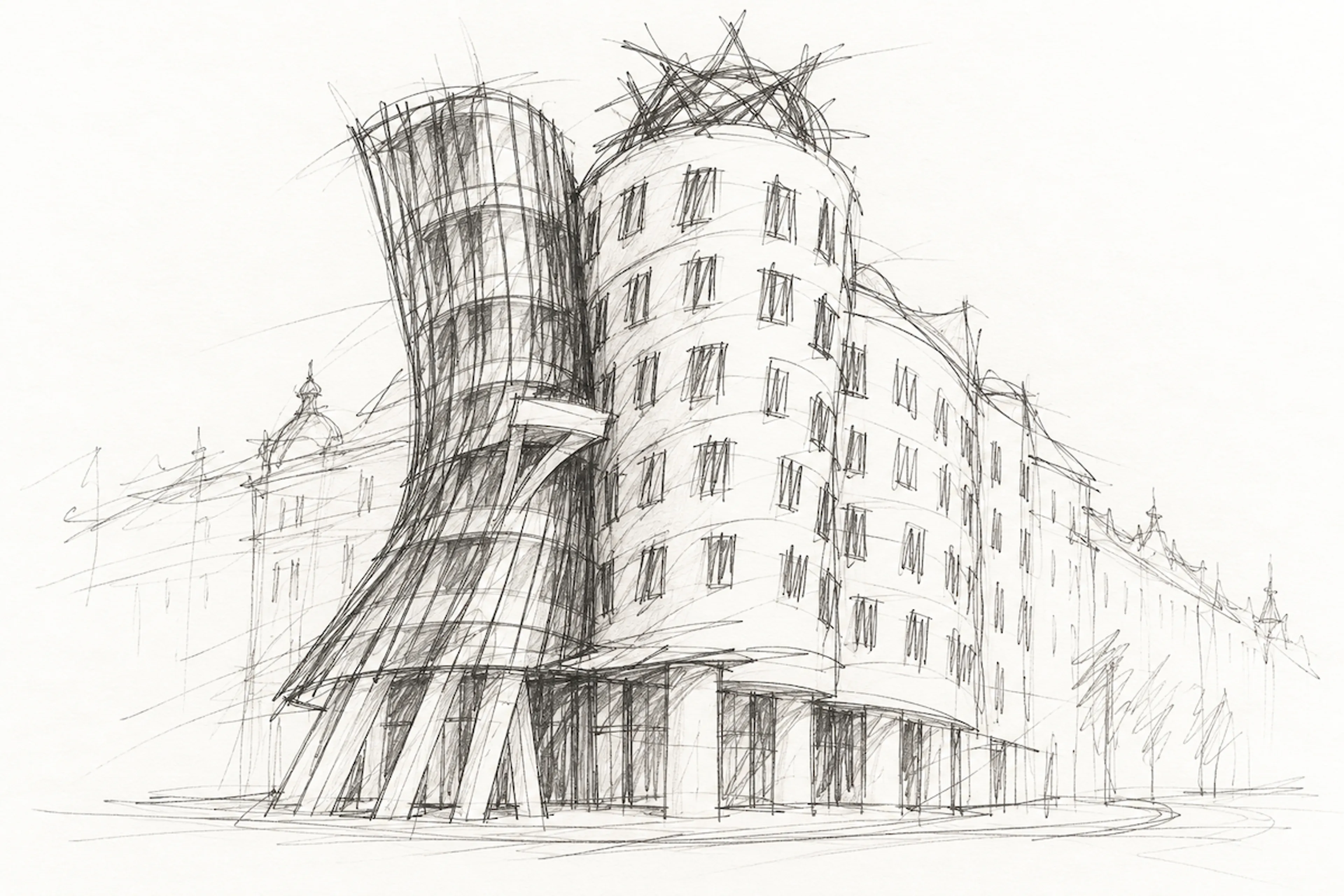
What makes a building exceptional? Its form, its relationship with the city, or its ability to capture the spirit of its time? To mark the Dancing House’s 30th anniversary, we share the perspectives of architects Josef Pleskot and Jiří Řezák. Their reflections bring together creative freedom and the courage to enter public space and transform it.
From the outset, the Dancing House invited debate about how contemporary architecture can find its place in a historic city. Both architects view it in the context of the years following the Velvet Revolution, which opened up room for new ideas and creative approaches. Each highlights a different aspect of its significance: Jiří Řezák emphasises courage and creative freedom, while Josef Pleskot reflects on its charisma and the way it has shaped a particular place in Prague.
Jiří Řezák: Courage That Still Inspires Thirty Years On
For Jiří Řezák of QARTA Architektura, the significance of the Dancing House extends beyond architecture itself. In his view, the building demonstrates how profoundly architecture can influence the society around it. The creative freedom it embodies remains an inspiration today.
“The Dancing House brought a refreshing breath of something new into our newly restored democracy. It showed the way forward for our society. A world-class architect with a distinctive creative approach demonstrated the kind of courage that people in advanced societies encounter in everyday life. Architecture shapes and profoundly influences not only public space, but also who we are. In this sense, for 30 years the building has continued to point us towards creative freedom and give us the courage we so greatly need.”
Josef Pleskot: A Building That Gave the City a Point of Reference
Josef Pleskot also turns his attention to the Dancing House’s relationship with its immediate surroundings. He considers its encroachment into public space—the very feature that drew criticism—to be one of its greatest strengths. He values the way the building has defined the relationship between the street, the embankment and the approach to the bridge, giving this location a clear identity.
“The Dancing House has a charisma that is difficult to define. It captivates many people. It was built at the right historical and social moment. After the Velvet Revolution, it became a symbol of the freedom to build in our country. Personally, what I value about it is precisely what attracted the most criticism: that it encroached unjustifiably into public space. Yet in doing so, it improved the urban setting at the approach to Jirásek Bridge, clearly marked the point where Resslova Street meets the embankment, and deftly defined an important place in Prague. It gave the city a new, solid and memorable point of reference. That rarely happens.”
The Dancing House’s 30th anniversary is an opportunity to look beyond its familiar silhouette. Both architects’ words remind us that a building’s significance also lies in what it makes possible, how it transforms its surroundings and the ideas it inspires in us. At the Dancing House, these dimensions come together at a single Prague address.
Other news
Other newsDo you have a question?
Write to us – we’ll get back to you as soon as possible.