

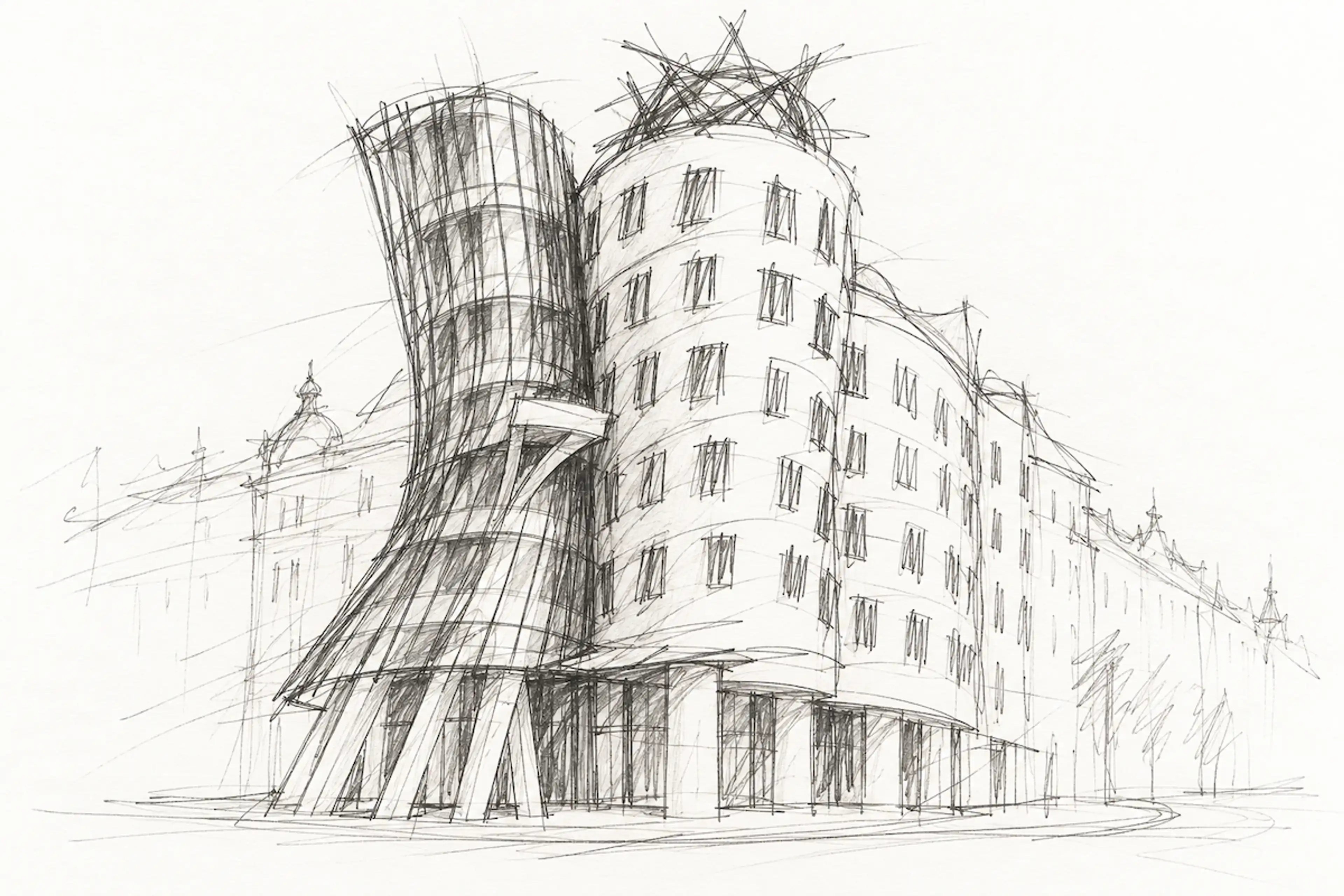
The Dancing House was created at a time when Prague was searching for a new identity. It found it in architecture that moves not only in form, but in thought.
It rose from the courage to go where no one expected. Not everyone understood it at the time.
It became a symbol of freedom, dialogue
and a new era of Czech architecture.
Explore its story

Empty Space in the City
The site where the Dancing House stands today remained vacant for a long time after the bombing in 1945. The gap at the corner of Rašínovo Embankment became a symbol of an unresolved urban space. It was precisely this uniqueness that later opened the way for more daring architecture.

When Visions Meet
The idea for the building emerged from a dialogue between architect Vlado Milunić and Václav Havel. It was not merely about filling a gap, but about creating a house with a cultural dimension. Frank Gehry was invited to join the project, approaching it as a smaller-scale experiment.

A Form Shaped Through Dialogue
The design evolved through collaboration between Milunić and Gehry, often through the exchange of physical models. The final form is a blend of distinct authorship and necessary compromises with its surroundings. It was at this stage that the silhouette emerged – one that clearly sets the building apart.

A Building That Sparked Debate
Constructing it in the historic city centre required sensitive technical and urban planning solutions. The project drew attention from both the public and experts even during its construction. Upon completion in 1996, it became a striking example of Prague’s contemporary architecture.

An Icon That Lives On
The Dancing House has found its place both in the city’s skyline and in its everyday life. Today, it brings together offices, a hotel, and gastronomy, attracting locals and visitors alike. What began as an experiment has become a respected symbol of contemporary architecture.


Did You Know…
The rooftop “Medusa” atop the Dancing House is made of stainless steel mesh, open at the top, and measures 7 metres in diameter.
The characteristic “pinched” waist of the “Ginger” tower also emerged as a practical solution: neighbours had complained about obstructed views, and this intervention required the design to be reworked.
During the design process, Gehry and Milunić exchanged physical models by post across the ocean (in a time before today’s digital tools), and Milunić described this exchange as “love letters.”
The Dancing House has become one of the most photographed buildings in the Czech Republic.
Without freedom, it would never have been built. Without courage, it would have remained just a dream.
A House That Isn’t Afraid to Be Itself

Václav Havel saw the Dancing House as more than architecture. He saw in it a symbol of openness, a dialogue with the world, and the courage to embrace difference.
Architecture in Motion
ONE BUILDING. DIFFERENT PERSPECTIVES
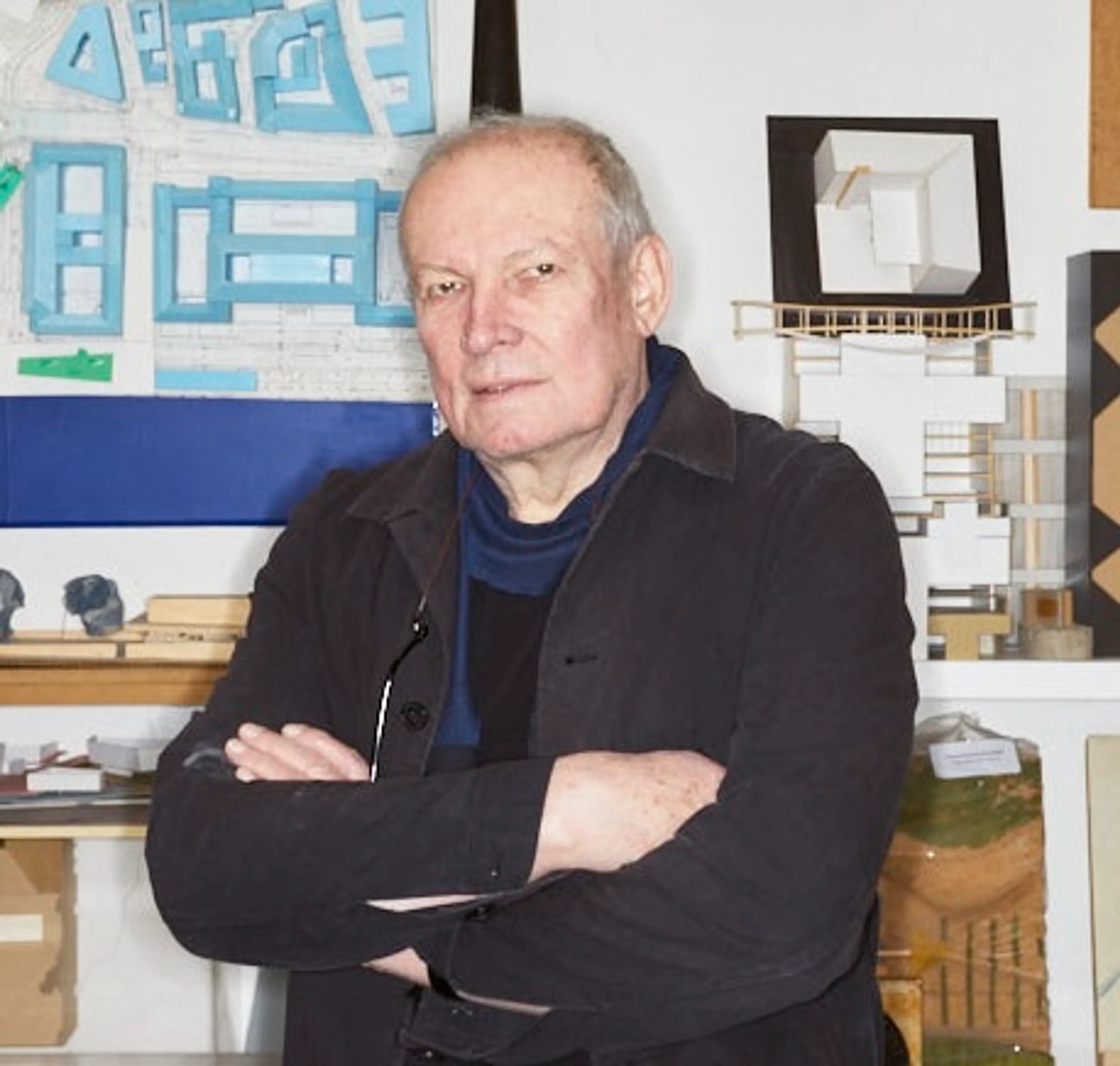
The Dancing House has a charisma that is difficult to define. It captivates many people. It was built at the right historical and social moment. After the Velvet Revolution, it became a symbol of the freedom to build in our country. Personally, what I value about it is precisely what attracted the most criticism: that it encroached unjustifiably into public space. Yet in doing so, it improved the urban setting at the approach to Jirásek Bridge, clearly marked the point where Resslova Street meets the embankment, and deftly defined an important place in Prague. It gave the city a new, solid and memorable point of reference. That rarely happens.
Josef Pleskot, architect, AP atelier
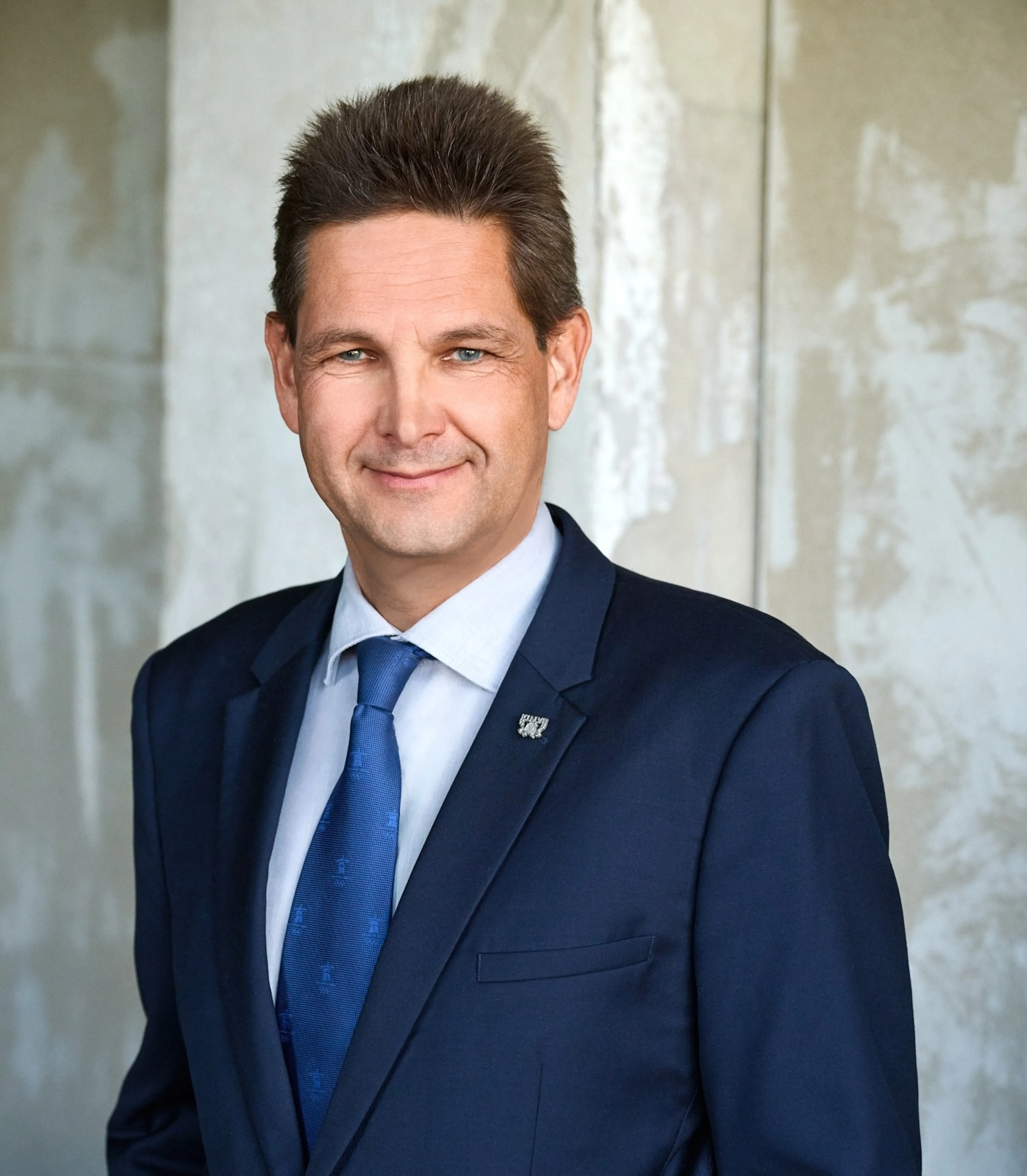
We acquired the Dancing House from ING at a time when it functioned as an office building closed to the public. A new vision under Mr. Skala gradually opened it up to people – introducing a gallery, restaurant, and café, and transforming it into a vibrant, living place.
Miroslav Kurťák, Acquisitions Manager, PSN
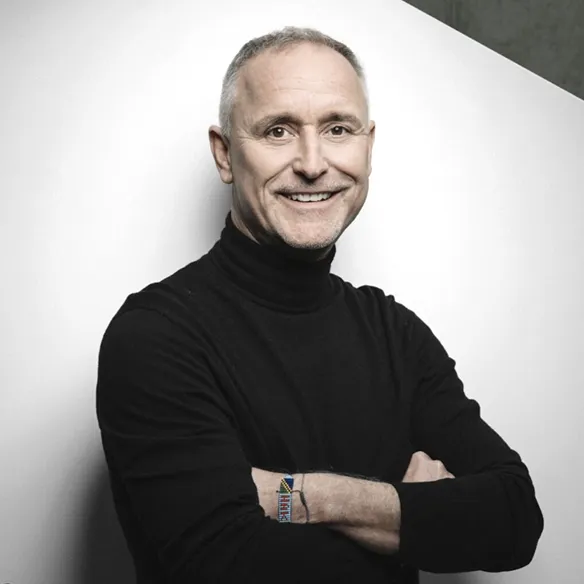
The Dancing House brought a refreshing breath of something new into our newly restored democracy. It showed the way forward for our society. A world-class architect with a distinctive creative approach demonstrated the kind of courage that people in advanced societies encounter in everyday life. Architecture shapes and profoundly influences not only public space, but also who we are. In this sense, for 30 years the building has continued to point us towards creative freedom and give us the courage we so greatly need.
Jiří Řezák, architect, QARTA Architektura
The Dancing House Is Not the PastIt Is Still in Motion
Today, the Dancing House is more than just an icon in photographs. It is a living place – one you come to for an experience: to stay, to taste, to explore.


It lives through culture. It lives through people.
It lives through the city. And it keeps dancing.
Your Messages to the Dancing House
14. 10. 2026
Every time I see it, I wonder how you’d furnish the rooms behind those crooked windows.
Marie
13. 9. 2026
For a long time, I’d only seen it in photos. When I finally saw it in person, I was surprised to find it right there among the other buildings, with trams going past. In the photos, it had looked like it stood on its own.
B.
14. 8. 2026
I’m really sorry I still haven’t seen the Dancing House in person. I’m just as disappointed that I’ll probably never get to see Kaplický’s library or the proposed Ferris wheel in Smíchov become a reality. Unfortunately, conservative attitudes and a fear of anything new win out far too often here. All it would take is a look beyond our own backyard — to Paris or Barcelona, for example.
Jaroslav Štefan
10. 7. 2026
Thirty years ago, I was studying architecture and working for an architecture magazine in Belarus. I wrote an article about the Dancing House back then and was truly excited about it. I’ve now been living in Prague for 13 years, and I still love Ginger and Fred. I work at the building authority, and I’d happily issue a building permit for a project like this ))
Naděžda Lobanová
21. 4. 2026
The Dancing House is part of what makes Prague Prague.
Natalie
8. 4. 2026
What I like about the Dancing House is that it doesn’t take itself too seriously.
Jirka from Dejvice

Do you have your own memory of the Dancing House?
A first impression, an encounter, a photograph, a story connected to it? Share it with us. We’re interested in how the building lives in your eyes – and what it means to you after 30 years.

News




Project Partners


Photography: PSN archive, Dancing House archive, and publicly available sources


